
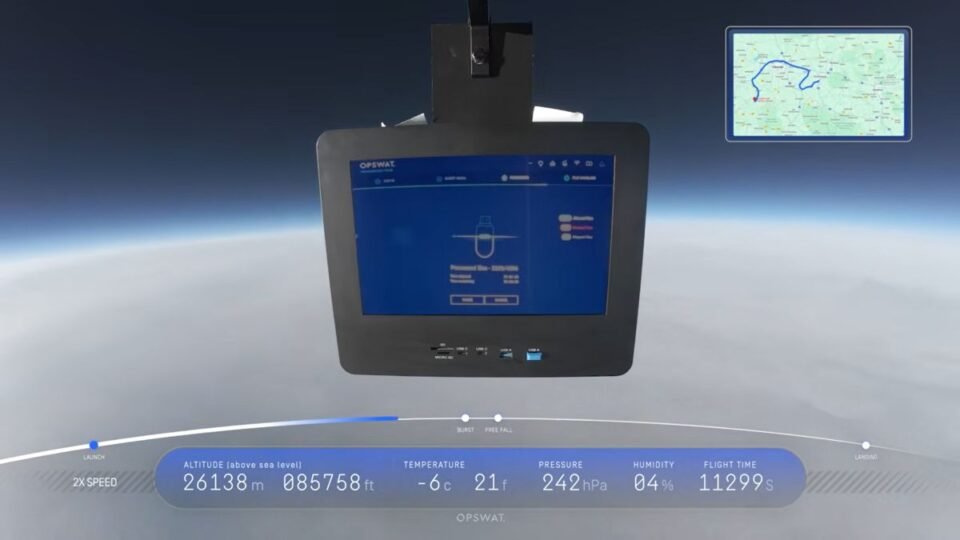
In its near-space mission, MetaDefender Kiosk Mini reached an altitude of 104,883 feet, exposed to high radiation, freezing temperatures (as low as -43.1°C), and near-vacuum pressures (9.5 hPa).
OPSWAT has released a video of its MetaDefender Kiosk Mini remained operational during a near-space test. MetaDefender Kiosk Mini sanitizes USB devices, external drives, and other removable media before they enter critical infrastructure environments. The device processed thousands of malware samples during the flight, according to OPSWAT.
How OPSWAT Sent MetaDefender Kiosk Mini into Near-Space
Attached to a weather balloon, the MetaDefender Kiosk Mini reached an altitude of 104,883 feet (31,968 meters), where it was exposed to high radiation, freezing temperatures (as low as -45.6°F, or -43.1°C), and near-vacuum pressures (9.5 hPa). After nearly 230 minutes, the balloon burst, but even in freefall, the kiosk kept sanitizing and operating until it landed in a river.
Speaking about the experiment, OPSWAT said the test demonstrates that MetaDefender Kiosk Mini can continue operating in extreme environments while processing removable media offline. The company said this supports its prevention-first cybersecurity approach for mission-critical systems where cloud connectivity or on-site support may be limited.
Watch the MetaDefender Kiosk Mini in near-space, technical cut video below.
In its Global Cybersecurity Outlook 2026 report, the WEF notes that 15% of global organizations now consider “dependence on space-based assets” (such as satellites, GPS, and satellite communications) in their overall cyber risk mitigation strategy.
While most public incidents today originate from terrestrial systems, as space programs evolve and access to orbit becomes cheaper and more common, cyberattacks will not always start on Earth, says OPSWAT.
“Space systems should be treated as critical infrastructure, and the cyber infrastructure that supports them should be treated as mission-critical infrastructure,” said Benny Czarny, Founder and CEO, OPSWAT. “Cybersecurity in space cannot be built around the idea that someone on Earth will always be available to fix the problem. It must be local, deterministic, segmented, and prevention-first.”
Join the Techitup Executive Network
Join the Middle East’s inner circle of C-Suite Tech Leaders. Exclusive access to closed-door regional roundtables, priority VIP seating at our annual awards, and strategic industry briefings.
During the near-space mission, the MetaDefender Kiosk Mini operated as an independent system using local compute. It did not rely on cloud connectivity during the flight—and used Deep CDR technology to process thousands of malware samples from removable media. Deep CDR technology assumes a file may be malicious, removes risky active content, and regenerates a clean version. This matters for space, defense, and other critical infrastructure environments where connectivity may be delayed, degraded, denied, or unavailable, according to OPSWAT.
During the near-space mission, MetaDefender Kiosk Mini was exposed to
- Frequent movements
- Drastic changes in temperature, from -45°F to ambient
- Humidity and water exposure
- High UV radiation
- Near-vacuum pressure
- Offline operation without cloud dependency
“More than the altitude, technology, and cool video, the idea was that cybersecurity has to work in environments where humans cannot easily reach, repair, or reset,” said Czarny. “In space, there is no simple onsite support, quick replacement, or easy second chance. The system must have full trust before it leaves the ground.”
Watch the MetaDefender Kiosk Mini in space launch video here.
Disclaimer: While the near-space test demonstrates the device’s operational resilience in harsh conditions, claims related to real-world space cyberattack simulation have not been independently verified by us. Readers are encouraged to review OPSWAT’s technical materials for additional context on the experiment.
