
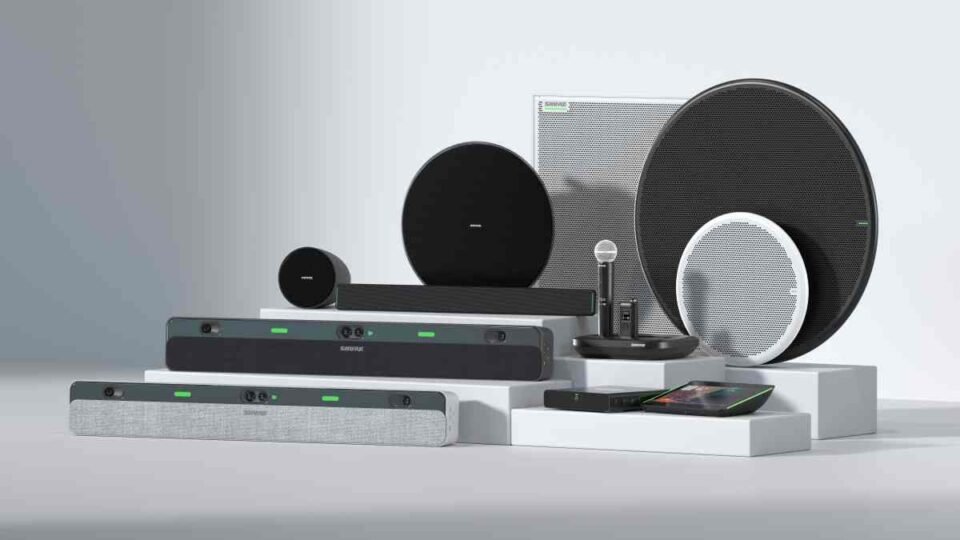
Patent-pending Microflex neXt Fusion Mode connects Microflex Wireless neXt with Microflex Advance to simplify audio deployment across boardrooms, classrooms and lecture halls.
Shure has introduced Microflex neXt Fusion Mode, a new patent-pending feature designed to bring its Microflex Wireless neXt and Microflex Advance microphone portfolios together within a unified audio system.
The new capability is aimed at extending audio coverage across medium and large enterprise and education spaces, including boardrooms, flexible classrooms, training rooms and lecture halls.
Microflex neXt Fusion Mode Highlights
At the centre of Fusion Mode is Shure’s built-in IntelliMix Digital Signal Processing. The integrated DSP can remove the need for additional external processors when expanding audio coverage, helping simplify system design and deployment.
Fusion Mode enables Microflex Wireless neXt transmitters and Microflex Advance array microphones to operate together. This allows wireless microphones to be used alongside ceiling array microphones in environments where presenters or participants may move around the room.
The system also includes automatic presenter prioritization, which gives priority to the wireless microphone while keeping the array microphones active for other participants and interactions.
Join the Techitup Executive Network
Join the Middle East’s inner circle of C-Suite Tech Leaders. Exclusive access to closed-door regional roundtables, priority VIP seating at our annual awards, and strategic industry briefings.
“Across the Middle East and Africa, organizations are looking for greater consistency as they expand their meeting, teaching and collaboration environments,” said Yassine Mannai, Associate Director, Sales, Shure MEA. “Microflex neXt Fusion Mode gives IT and AV teams the flexibility to extend coverage across larger and more dynamic spaces while simplifying the infrastructure required to deploy and manage the system.”
The feature is designed for IT and AV teams managing larger classrooms, lecture halls, boardrooms, divisible spaces and multi-room projects, allowing wireless and ceiling array microphone technologies to be combined according to the requirements of each environment.
Fusion Mode supports both sound reinforcement and videoconferencing, while reducing reliance on external audio processing hardware.
