
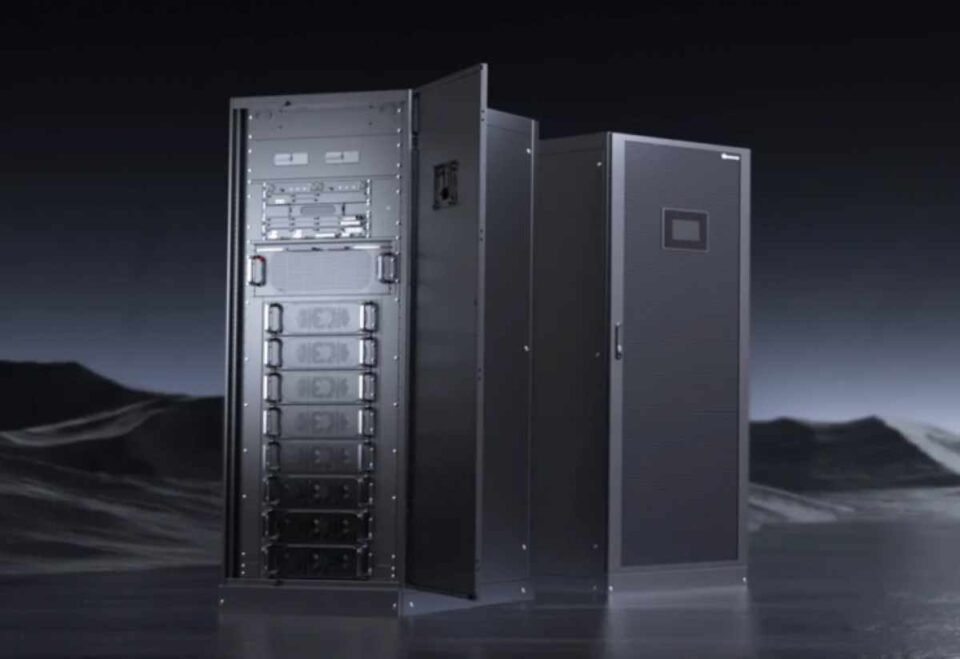
Legacy ECO vs. Huawei Adaptive S-ECO: A Deep Dive into Solving the AI Data Center Energy Crisis.
By Techitup Editorial Team
Overview & Industry Context: AI Data Center Energy Crisis
As the global AI wave accelerates, compute density is escalating at a pace the power grid was never designed to handle. While industry headlines focus on massive GPU clusters, facility engineers face a quieter crisis: single-chip AI training power has jumped from tens of watts to hundreds of watts, driving individual rack densities toward 100 kW. Campus-scale data center requirements are rapidly scaling from hundreds of megawatts (MW) into gigawatt (GW) territory.
As we explored in our previous coverage on the environmental cost of AI, scaling compute without rethinking energy efficiency isn’t sustainable. At the core of this challenge sits the Uninterruptible Power Supply (UPS). Traditional power architectures are hitting physical limits in thermal management and energy conversion. To keep up, enterprise operators need to eliminate power conversion losses across the supply chain while maintaining rock-solid power continuity for mission-critical AI workloads.
The Challenge: Why Legacy UPS Topologies Are Failing AI Workloads
Data centers have traditionally relied on online double-conversion UPS architectures to ensure uptime. Under double conversion, AC power from the grid is rectified to DC power and then inverted back to AC power before reaching the servers.
Traditional Double-Conversion Topology:
| [Utility Grid AC Input] ──> [Rectifier (AC->DC)] ──> [Inverter (DC->AC)] ──> [Critical IT Load] |
While converting power twice guarantees clean, isolated electricity, it creates continuous conversion losses and extra heat. At multi-megawatt scale, this extra heat raises Power Usage Effectiveness (PUE) scores, inflates electricity bills, and puts prolonged thermal stress on power components.
To cut these losses, many facilities adopted ECO mode, which bypasses the rectifier and inverter during periods of stable grid power to feed servers directly.
While ECO mode improves energy efficiency, Huawei’s engineering analysis identifies three major operational risks that make legacy ECO mode unsuitable for high-density AI data centers:
- Switching Delays (2 ms to 20 ms): When grid anomalies occur, switching from bypass back to inverter power takes between 2 ms and 20 ms. For highly sensitive AI compute clusters, even a momentary gap can cause severe system downtime.
- Zero Power Quality Management: Direct bypass mode does not provide active harmonic filtering. Non-linear facility hardware—such as cooling equipment, fans, and air conditioning systems operating without Power Factor Correction (PFC)—generates heavy harmonics that feed back into the grid, causing severe grid pollution.
- Circulating Currents & Overload in Parallel Configurations: Large data centers run multiple UPS systems in parallel. Variations in internal components or total incoming/outgoing cable lengths create path impedance differences. Current naturally flows through the path of least resistance, causing current imbalance that overloads individual UPS units and leads to system failures.
The Technical Solution: Huawei Adaptive S-ECO Architecture
To eliminate the compromise between ECO mode efficiency and double-conversion reliability, Huawei engineered the Adaptive S-ECO mode (featured in the UPS5000-H Series). S-ECO is a complete rethinking of underlying power topology and control logic based on three fundamental engineering innovations:
Huawei S-ECO Architecture
| Hardware Clamping 1. Hot-backup inverter 2. 0 ms transfer time 3. 99.1% efficiency | Active Harmonic Compensation 1. Real-time inverse phase 2. Distortion <5% THDi | Active Current Sharing 1. Dynamic SCR firing 2. <5% parallel imbalance |
1. Hardware Clamping Technology (0 ms Transfer Time)
In standard ECO mode, switching back to inverter power suffers from multiple accumulated delays: bypass detection delay, control signal transmission delay, thyristor zero-crossing turn-off delay, and inverter startup delay.
Huawei S-ECO solves this by introducing proprietary hardware clamping technology paired with a hot-backup inverter unit at the inverter output. The RMS voltage of this hot-backup inverter is continuously maintained just slightly below the RMS voltage of the bypass utility supply.
When grid voltage drops, the hot-backup inverter takes over power delivery instantly. This delivers true 0 ms seamless transfer, fully meeting IEC 62040-3 Class 1 dynamic response requirements while maintaining system operational efficiency of up to 99.1%.
2. Active Harmonic Compensation (Eliminating Grid Pollution)
When facility cooling systems and non-linear equipment run directly on bypass without PFC, they create reactive power and higher-order harmonics.
Under S-ECO, the system continuously monitors the current load at the UPS output, separates the harmonic components, and feeds the data to the inverter in real time. The inverter—operating in hot-backup mode as an active current source—generates compensation current with the exact same amplitude but opposite phase as the load harmonics.
Harmonic Cancellation Mechanism:
| Bypass Current (Ibps) + Inverter Compensation Current (Iinv) = Clean Fundamental Load Current (Iload) |
Real-World Test Results:
- Without Compensation: When non-linear loads make up 30% of system load (PF = 0.7), input current distortion under traditional bypass exceeds 70% THDi.
- With Active Compensation: Input current distortion drops below 10% THDi under non-linear loads. At full load, with system input power factor PF > 0.99, input current distortion is constrained to below 5% THDi.
3. Active Current Sharing in Parallel Operations
Instead of forcing data centers to install bulky, expensive impedance inductors along each bypass path, Huawei S-ECO introduces an active software-and-hardware current-sharing control. The system continuously monitors the bypass current of each parallel module and dynamically adjusts the firing angle of the Silicon-Controlled Rectifiers (SCR). By adjusting the SCR’s dynamic equivalent impedance on the fly, power distribution across parallel units is actively balanced.
Extreme Stress Test Verification: Huawei conducted extreme test scenarios where total input/output cable lengths of two parallel UPS systems differed by a factor of two (2:1 disparity):
- When minimum rack current was 15% or higher, parallel current imbalance under resistive-load conditions was kept within 5% (compared to an industry norm of around 30%).
- Under non-linear load conditions (PF > 0.7), current imbalance was kept within 10%.
Quantifiable Business & Operational Impact
Technological innovations only matter if they translate into financial performance. Huawei’s S-ECO architecture impacts total cost of ownership (TCO) across two primary metrics:
TCO Impact Summary:
| Conversion Efficiency: Up to 99.1% across load profiles |
| Annual Power Savings: Tens of Millions of RMB (for 100 MW facility) |
| Uptime Guarantee: 0 ms transfer time (IEC 62040-3 Class 1 compliant) |
| Grid Protection: Input current distortion reduced to < 5% THDi |
| Asset Lifecycle: Equipment lifespan extended from ~10 years to ~15 years |
- Immediate Operating Cost Reductions: By maintaining up to 99.1% efficiency across variable load ranges, S-ECO significantly cuts energy loss. For a standard 100 MW data center, switching from traditional double-conversion to Huawei UPS Adaptive S-ECO mode saves tens of millions of RMB in annual electricity costs.
- Asset Protection & Extended Lifecycle: Because main power components spend most of their operational life in a low-stress “hot standby” state, thermal degradation is substantially reduced. This operational model extends equipment service life from the typical 10-year industry baseline up to 15 years.
Conclusion
A 1% efficiency gain might sound minor on paper, but across multi-megawatt AI clusters, it amounts to massive financial and environmental savings. By solving the three legacy challenges of ECO mode—0 ms switching latency, active harmonic control, and parallel load balancing—the Huawei UPS5000-H Series with Adaptive S-ECO proves that modern data centers no longer need to compromise reliability for efficiency.
Disclaimer: This tech feature evaluates data center UPS topologies using technical material, benchmark tests, and data provided by Huawei. Efficiency claims, latency figures, and TCO projections reflect vendor test conditions and analytical models.
